Correcting Perspectives
In this blog I explore how drawing perspective can sometimes be challenging particularly on a large scale canvas. Explore the challenges of creating an under drawing free hand with me and how to scale your under drawing from an original photograph. Learn how human perspectives alter reality.
Siobhan Guthrie
4/16/20262 min read
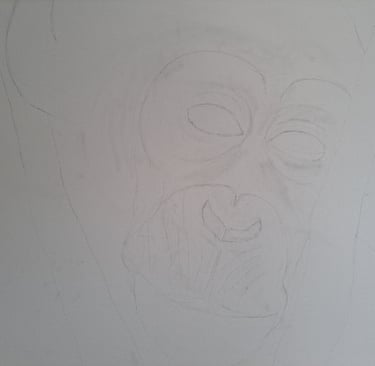
Sometimes the underdrawing doesn’t go to plan in the first instance. My current commission is a large A1 size portrait of a chimpanzee and this is the largest painting I have created. The end result is going to be a highly detailed painting and so proportions are key. If it is not right at the beginning, it will never be in proportion when I start adding layers of paint. At a painting class I was told that getting perspective wrong is not really our fault because the human eye sees perspective differently to how it is in reality. As artists we have to think differently, we have to train ourselves and trick our brains by really looking at our subject to get everything in proportion. Hans Holbein the Younger’s skull illusion in The Ambassadors always fascinates me and it is an image I return to time and again for lessons in perspectives. I recommend you Google search the image or indeed go and see it for yourself at The National Gallery in London!
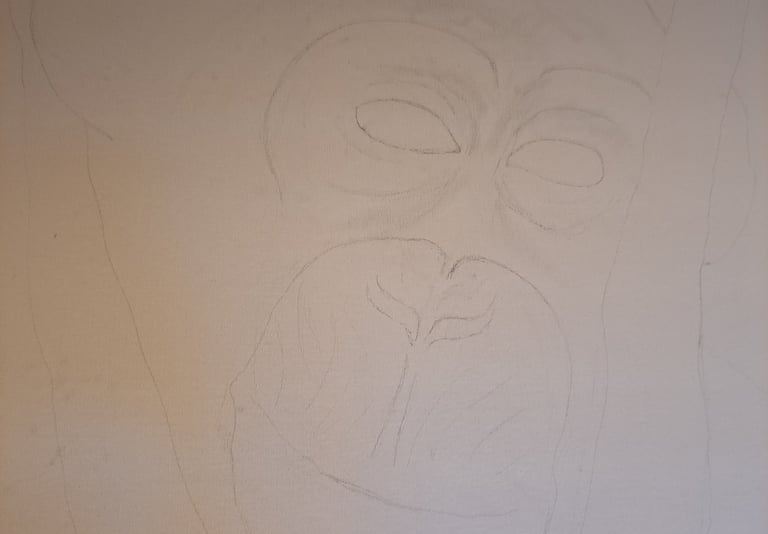
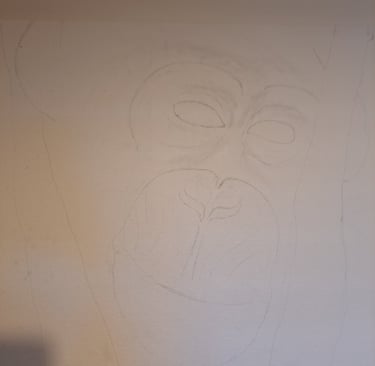
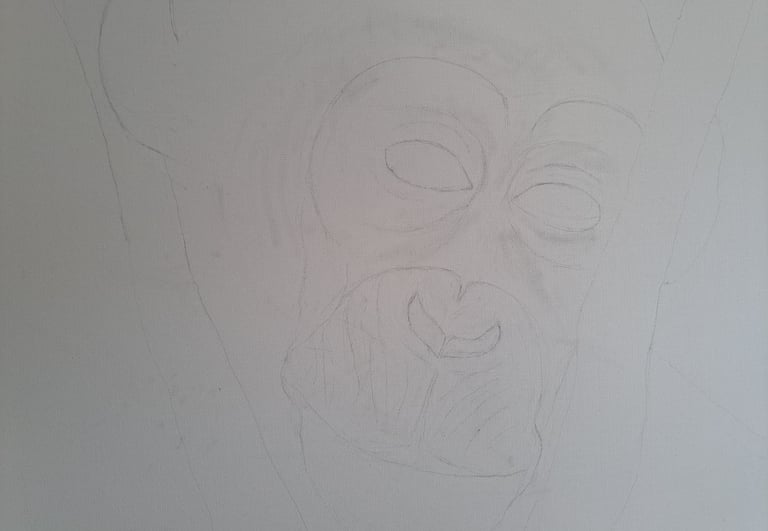
Stepping back from my underdrawing I realised that the brow, nose and nostrils were slightly misaligned. I therefore had to make several adjustments including moving my underdrawing for the right eye. I really focused on training my eye to imagine a line going through the middle of the brow bone as I realised from the photograph that this would be the easiest way to draw all of the facial features in proportion. Now I will be able to paint the facial features facing in the correct direction rather than the muzzle looking off-centre compared to the top of the chimpanzee’s head. Correcting my initial mistakes has enabled me to grow as an artist and I really enjoy the challenge of aiming to draw more accurately. I always take each new commission or painting as an exciting new challenge to complete. This allows me to develop new techniques and bring out the best of my creativity.
Often I use the line and graphite method using tracing paper to copy the image onto the paper or canvas, however as this painting is on such a large scale, I had to create the underdrawing freehand. This meant I took several measurements from the original photograph and enlarged these measurements by four. Drawing freehand on a large scale has been tricky but I have enjoyed the process of really focusing on all the lines, curves, reference points, basic shapes and I think this will benefit me when I come to add layers of paint. I hope to become better at noticing detail in shapes and shadows of the subject.
Contact
If you have any questions about my creative processes or wish to commission a work please contact me. If you would like to commission a pet portrait, please write your pet's name/s in the subject line of the email along with a photograph for me to work from.
© 2026. All rights reserved